

Blog
Types of Disabilities

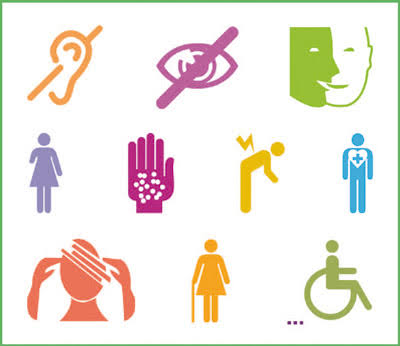
In our daily lives, we may encounter someone suffering from a certain disability.
In order to be aware and careful in dealing with them, it is necessary to understand the types of disabilities because we might not be aware that a certain condition is considered a type of disability.
Disabilities include visual impairment, hearing impairment, mental disability, physical and motor disability, learning difficulties, speech and language disorders, behavioral and emotional disorders, autism, double and multiple disabilities, and other disabilities that require special care.
Each disability varies in its severity from one person to another, as well as its treatability.
1. Motor Disability:
Motor disability is divided into five types:
First: Cerebral Palsy cases:
It is a deficiency in the nervous system in the brain area, resulting in paralysis that affects either all four limbs, the lower limbs only, or one side of the body, whether the right side or the left side. This paralysis results in a loss of ability to control various voluntary movements.
Second: Progressive Muscular Dystrophy:
A hereditary disease that begins by affecting the voluntary muscles in the patient’s four limbs, then shifts to affect the rest of the involuntary muscles.
Third: Cases of fission or occurrence of a cleft in the vertebrae of the spinal column:
Vital cells in the spinal cord are severely injured when parts of them protrude, and their basic functions are totally or partially disrupted.
Fourth: Various congenital deformities:
These are various congenital deformities that occur due to hereditary or non-hereditary reasons during an abnormal pregnancy, affecting the joints or bones. These deformities appear either in the form of stunted growth of the limbs or a strange curvature in the bones.
Fifth: Other cases with different diagnoses:
These are various cases as follows: (Polio, osteoporosis, endocrine gland disorders, spinal cord diseases, chronic peripheral nerve diseases, and other chronic diseases affecting the blood vessels).
2. Mental Disability:
Intellectual disability is defined as a state of arrested or incomplete mental development, characterized specifically by impairment in skills, appearing during the developmental cycle, and affecting the general level of intelligence, i.e., cognitive, linguistic, motor, and social abilities. Retardation may occur with or without another psychological or physical disorder.
Among the most famous is Down Syndrome, which is a congenital disorder resulting from the presence of an extra chromosome in the body’s cells, and the percentage increases with the mother’s age.
3. Visual Impairment:
Visual impairment ranges between total and partial blindness, and on this basis, there are two types of visual impairment:
-
The blind, whose visual condition requires the use of the Braille method.
-
The visually impaired, who can see through visual aids.
4. Hearing Impairment:
Hearing impairment is a general term covering a wide range of degrees of hearing loss, ranging from deafness, severe loss, and mild loss. Its signs may be visible or hidden, which leads to problems in the child’s life without knowing the cause, such as academic failure. The child may be described as stupid for not interacting with others. It is usually accompanied by many disabilities, such as: (Down syndrome, cerebral palsy, intellectual disability, autism, ADHD, cleft palate, and cleft lip).
